


A simple guide to understanding wetland food webs
Wetland food webs connect algae, insects, amphibians, fish and birds in complex ways that change with the seasons.

Stand at the edge of any UK pond, fen or grazing marsh and you are looking at a food web in motion. Not a tidy chain with a neat top and bottom, but a shifting map of who eats whom, redrawn every few weeks as water levels, temperature and day length change. Getting to grips with the basics helps you read a wetland far more accurately — and makes it obvious why small changes in water quality or habitat can ripple all the way up to bitterns and otters.
Energy starts in the shallows — and in the dead stuff
Wetland food webs begin with plants and algae capturing sunlight. In a nutrient-rich lowland pond you will find blanketweed, duckweed, pondweeds, water starwort and stoneworts, plus a film of algae coating every reed stem and submerged twig. Microscopic phytoplankton drifts in the open water. All of it converts sunlight into food that something else can eat.
What surprises many people is how much of the web runs on dead plant matter rather than fresh grazing. Every autumn, reeds, sedges and willow leaves drop into the water and are broken down by bacteria and fungi into a rich sludge of detritus. In many fenland dykes this detrital pathway supplies more energy than living plants do. That is why a wetland with plenty of decaying vegetation can support so much life: the base of the web is not only green, it is brown as well.
The middle of the web: invertebrates beyond counting
This is where a wetland gets busy. Caddisfly larvae in their cases of grit and plant fragments, mayfly nymphs clinging to stones, chironomid midge larvae — the bloodworms that give silt its red thread — water boatmen, whirligig beetles, great diving beetles, damselfly nymphs and freshwater shrimp. Each occupies a slightly different niche, and together they form the hinge of the entire system.
It helps to think of them in three rough groups:
- Shredders — caddisfly larvae and water slaters that chew fallen leaves into smaller pieces, releasing nutrients for everything downstream.
- Grazers — mayfly nymphs, water snails and pea mussels that scrape algae off stems and stones.
- Predators — diving beetles, dragonfly nymphs and water scorpions that hunt other invertebrates, and are themselves food for fish, amphibians and birds.
Because most of these invertebrates spend weeks or months underwater, they are excellent indicators of a wetland's health. A dyke with a wide range of mayfly and caddisfly families is usually clean and well oxygenated. One dominated by midge larvae and water slaters is often enriched, silty and short of oxygen.
Amphibians, fish and shifting positions
Common frogs, common toads, smooth newts and great crested newts move between water and land, which makes them unusually flexible web members. A tadpole grazes algae and detritus; the frog it becomes eats slugs, flies and beetles in damp grass. Eggs and larvae are eaten by fish, dragonfly nymphs and herons in turn.
Fish sit in the middle to upper layers. Three-spined sticklebacks and minnows take small invertebrates; rudd and roach graze and pick; perch and pike hunt other fish. Eels are especially important in UK wetlands, feeding on invertebrates and small fish in the silty margins and travelling between fresh and salt water over their lives.
The key idea here is that an animal's position in the web changes with its age and the season. A pike is a top predator at four years old and a snack at four weeks.
Birds and mammals at the top
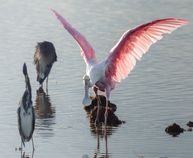
Above the water, the web fans out. Grey herons and bitterns stalk fish, eels and amphibians in shallow margins. Great crested and little grebes dive for fish and invertebrates. Marsh harriers quarter reedbeds for voles, frogs and young waterfowl, while hobbies take dragonflies on the wing. Kingfishers and Daubenton's bats work the open water at different times of day.
Mammals join in from the bank. Otters take fish, eels and the occasional waterbird; water shrews hunt invertebrates along the waterline; water voles graze bankside plants and are themselves prey for otters, herons and birds of prey. Nothing is truly top of the web — scavengers and decomposers return every one of them to the detritus at the bottom, and the cycle starts again.
Why the whole web re-plumbs itself with the seasons
Wetlands run on pulses. In spring, lengthening days and warming shallows trigger an algal bloom, then a burst of invertebrate growth, then amphibian breeding, then a wave of nesting birds. Late spring brings the great midge and mayfly emergences, when insects leaving the water feed warblers, swallows and bats — a transfer of energy from water to land.
Summer drawdown concentrates prey into shrinking pools, which suits herons and otters. Autumn leaf fall feeds the shredders and rebuilds the detritus store, while wildfowl arrive from the north to graze and dabble. Winter is the quietest time at the surface but the busiest for ducks and swans, and the hardest for bitterns, which need unfrozen channels holding enough fish and eels to see them through.
Reading a wetland food web for yourself
You do not need a laboratory. Kneel at the edge and turn over a lily pad to see the grazers and the egg masses stuck to it. Watch where a heron stands: it is fishing a channel where small fish are funnelled by weed. Look for otter spraints on a bridge or a flat stone, and for nibbled stems that show where water voles have been feeding.
- Keep a vegetated margin. Reeds, sedges and rushes shelter invertebrates and the fish that eat them.
- Cut reedbeds in rotation rather than all at once, so some tall structure always remains.
- Leave shallow, muddy edges that warm quickly in spring — they are the engine room for tadpoles and insect larvae.
- Reduce nutrient and sediment runoff from paths, fields and gardens nearby.
- Never move fish, spawn or pond plants between waters, and report invasive non-native species such as floating pennywort and signal crayfish.
Do those things and you are not just protecting individual species. You are keeping the whole tangle of connections intact — which is what a wetland, at its best, really is.

Post a comment